
10 PPC Audit Tool Options for Smarter Account Reviews
Compare 10 ppc audit tool options by features, use cases, limitations, and fit for multi-account workflows and automation stacks.
- ppc audit tool
- PPC auditing
- Google Ads tools
- ad automation
- paid media software
You’re staring at a scorecard, an alert, or a sudden drop in spend efficiency, and the substantive work still hasn’t started. A PPC audit tool is only useful if your team can investigate the issue, assign the fix, verify the outcome, and keep a record across multiple accounts. That’s why the best comparison isn’t just “which tool scores accounts,” it’s what happens next.
I’d compare these tools on network coverage, audit cadence, diagnostic depth, reporting, automation, governance, pricing model, and execution scope. Some platforms are built for continuous monitoring, some are fast snapshot graders, and some sit closer to an operating system for paid media teams. If you want a broader starting point on how teams audit your pay per click, that framing helps, but the tool choice still depends on whether you need a cleaner report, a deeper diagnosis, or a way to act on the finding.
Table of Contents
- 1. TrueClicks
- 2. Adalysis
- 3. Optmyzr
- 4. Opteo
- 5. WordStream Google Ads Performance Grader
- 6. SEISO
- 7. Karooya
- 8. Adsbot
- 9. Madgicx
- 10. Clever Ads Google Ads Audit
- Top 10 PPC Audit Tools Comparison
- Turn Audit Findings Into a Repeatable Operating System
1. TrueClicks
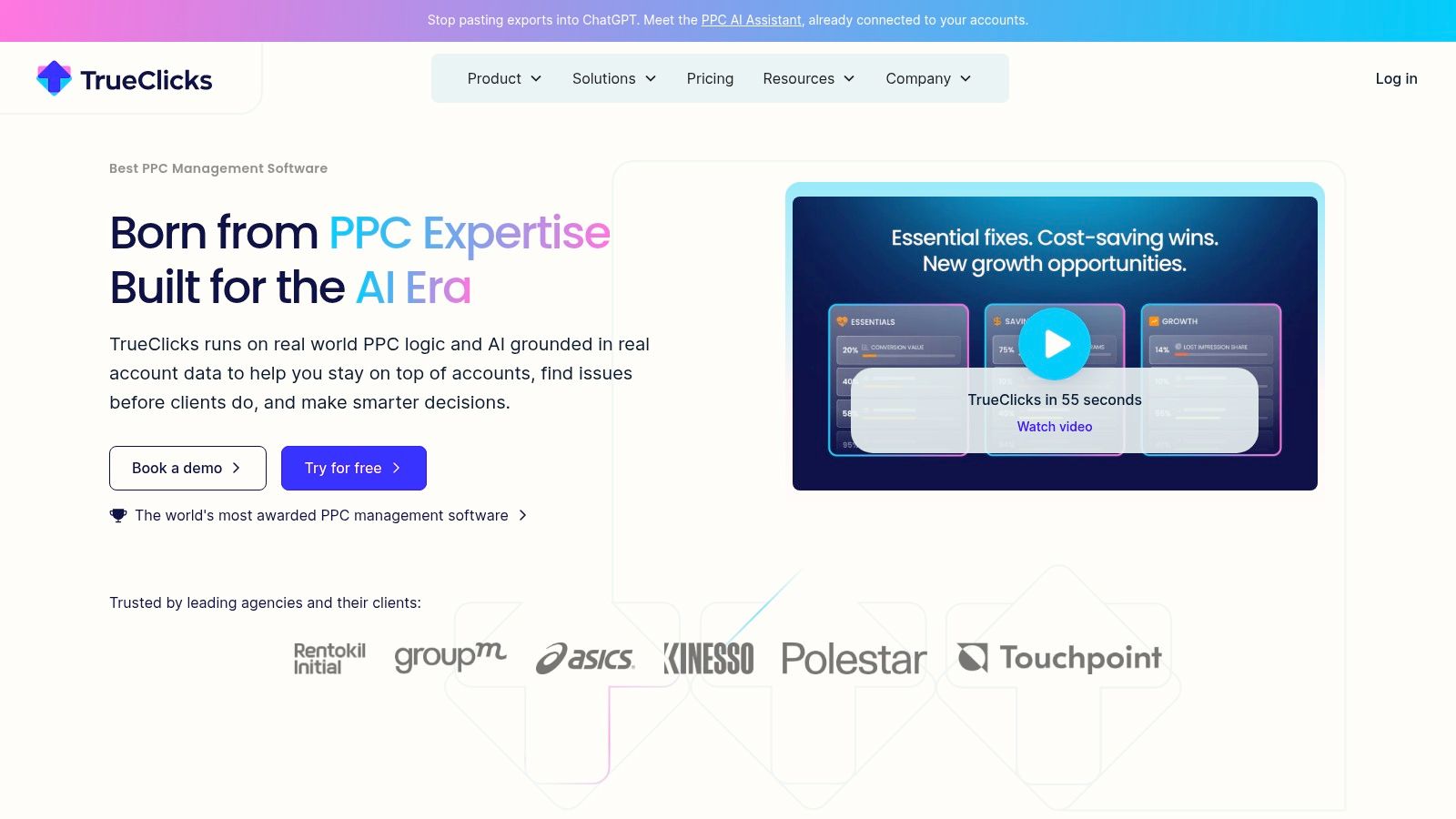
TrueClicks fits teams that want account-health auditing without a lot of noise. The strongest use case is agency work across Google Ads and Microsoft Advertising, where hygiene checks, tracking gaps, policy issues, and wasted spend need to be found consistently, not just once in a while.
Where it works best
TrueClicks is built around automated checks, alerting, and shareable audits. That makes it a good fit when you manage multiple accounts and need a repeatable review process instead of a manual teardown every quarter. The platform’s practical value is in surfacing issues that daily reporting often misses, then pointing people straight to the entity that needs attention.
Practical rule: use TrueClicks when you want a steady hygiene layer, not a creative-testing suite or a bulk build engine.
Trade-offs to watch
The trade-off is scope. If your team needs more than monitoring and audit logic, TrueClicks won’t replace a broader management stack. It’s strongest as an objective reviewer, weaker as an execution workspace.
For teams comparing operating models, it helps to separate diagnosis from action. TrueClicks is mostly diagnosis. If you need help coordinating the fix after the audit, that’s where a separate execution layer can become useful.
2. Adalysis
Adalysis is one of the more mature choices for teams that treat auditing as a continuous workflow instead of a one-time report. It’s especially relevant for Google Ads and Microsoft Advertising accounts where rule-based review, testing, and change tracking matter as much as the audit itself.
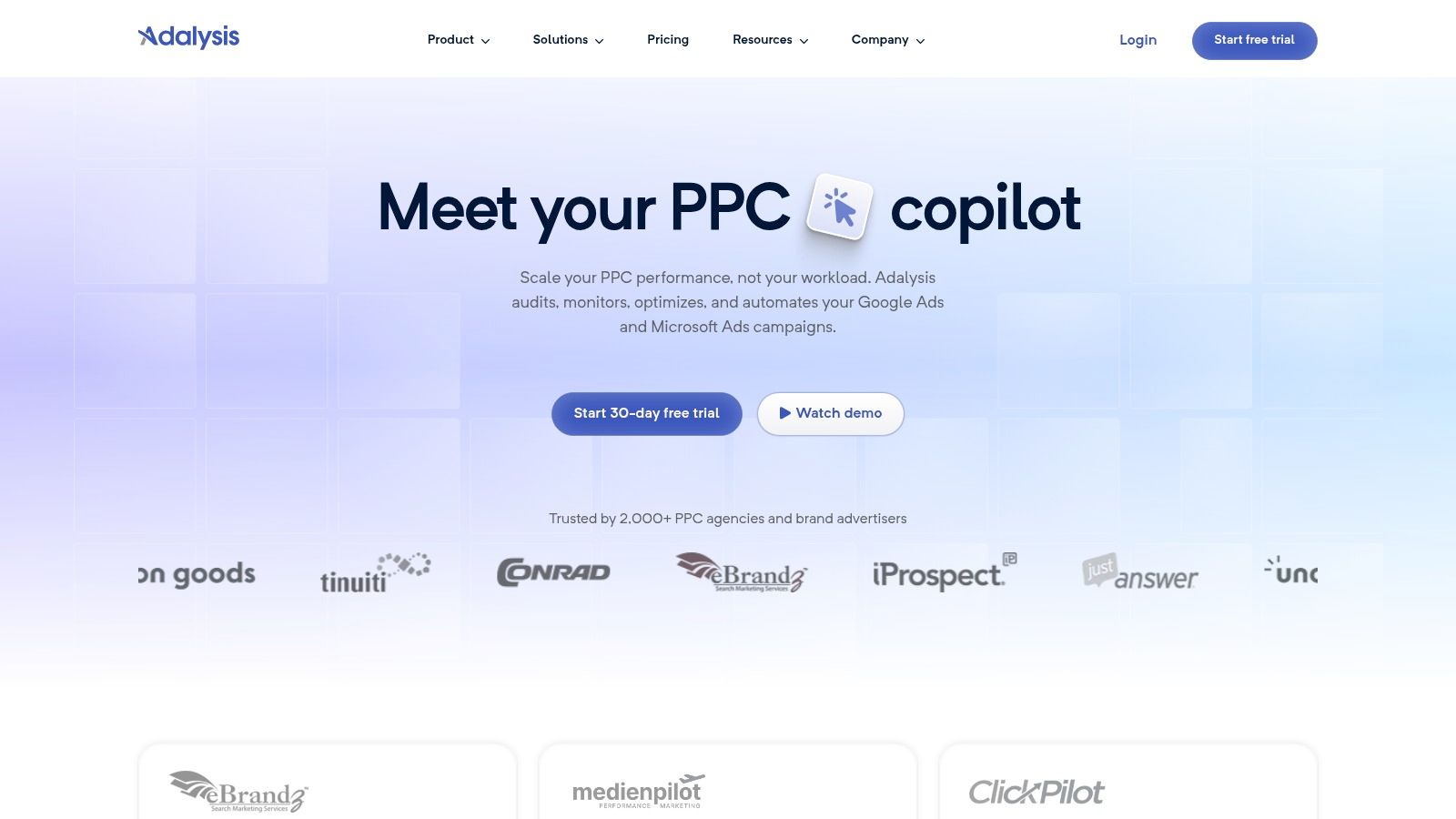
It stands out because it doesn’t stop at issue detection. The platform combines always-on audit alerts, variance and root-cause analysis, change tracking, and reporting templates. In practice, that means a client-facing summary can show what changed, why it changed, and which issue needs attention next.
The value is obvious for larger teams. You’re not just identifying underperforming ads or broken settings, you’re building guardrails around how accounts are reviewed and updated. That’s why it feels closer to a disciplined QA layer than a simple grader.
Paid search management tools often sit in this same operational lane, but Adalysis stays more centered on audit and optimization logic than on multi-network execution.
Where it falls short
The downside is complexity. Smaller advertisers can find it dense, and pricing tied to spend can make it feel heavy if you’re only managing one or two modest accounts. It’s strong when process matters, less attractive when you want a lightweight pulse check.
3. Optmyzr
Optmyzr is the broadest platform in this list for teams that want audits plus follow-through. It’s not just an auditor, it’s a management suite with rule automation, feed tools, Performance Max governance checks, and detailed activity logging.
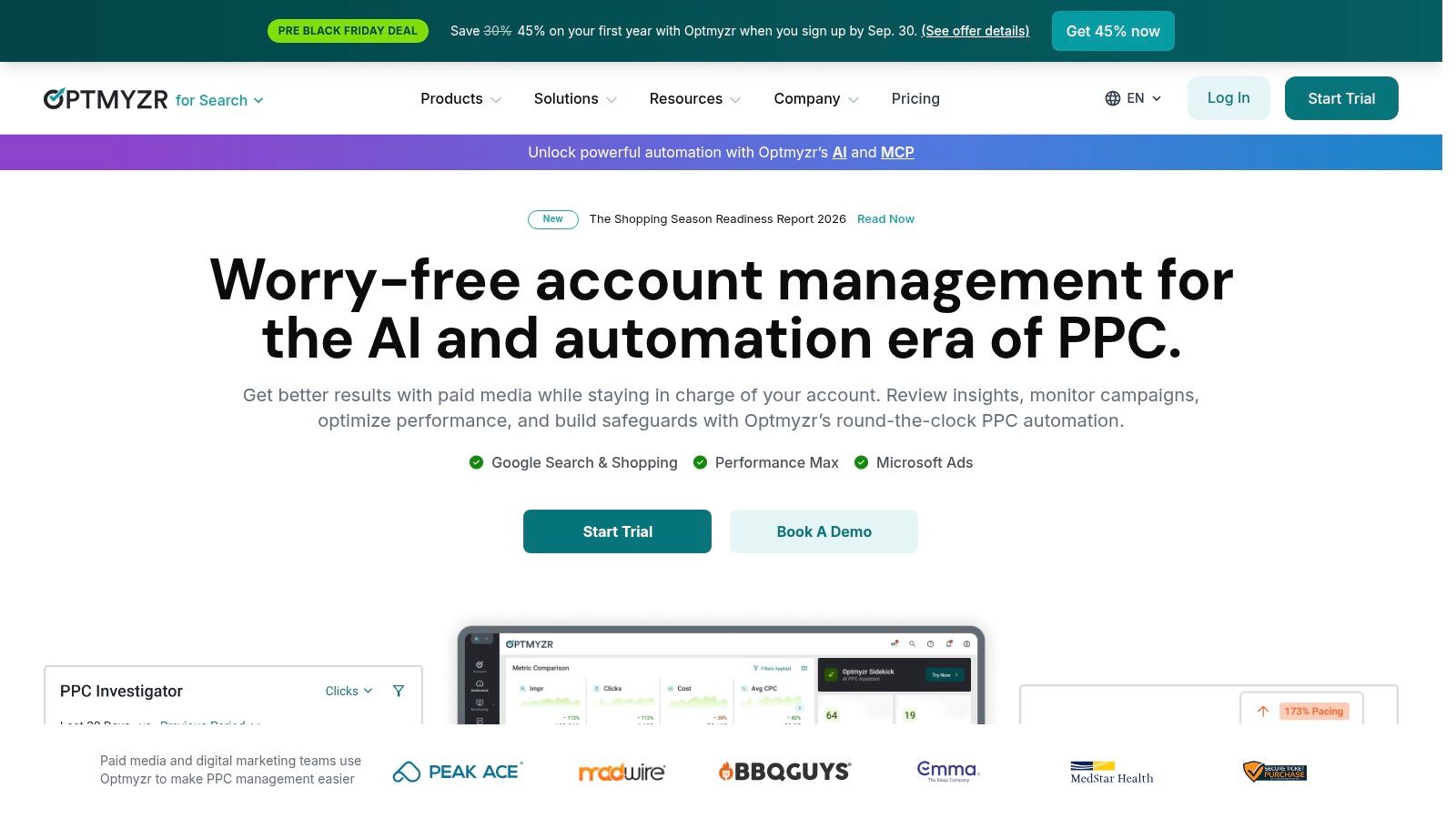
The biggest advantage is operational depth. A health issue can be spotted, reviewed, and then pushed into an automation or campaign workflow without forcing the team to jump between disconnected tools. That makes Optmyzr especially useful for agencies managing many Google accounts where governance and apply logs matter.
Strong fit for larger account sets
Optmyzr works best when the team already has a process for triage, approval, and implementation. It gives you the audit layer, but it also helps you operationalize fixes. That matters if your problem isn’t just spotting broken performance, it’s making sure the fix is deployed, logged, and traceable.
A few teams use a setup like this when they want the audit layer to remain separate from the execution layer, but still closely connected.
Google Ads automation tools often overlap here conceptually, but Optmyzr is the more obvious choice if your priority is a mature Google-first management stack.
Trade-offs
The learning curve is real. The value rises with account volume and complexity, so it can feel expensive or overbuilt for single-account users. It’s a strong choice for operationally mature teams, not a casual grader.
4. Opteo
Opteo is the cleanest option for smaller teams that want simple, continuous recommendations for Google Ads. It’s less intimidating than the bigger suites and easier to adopt if you don’t want a long implementation cycle.
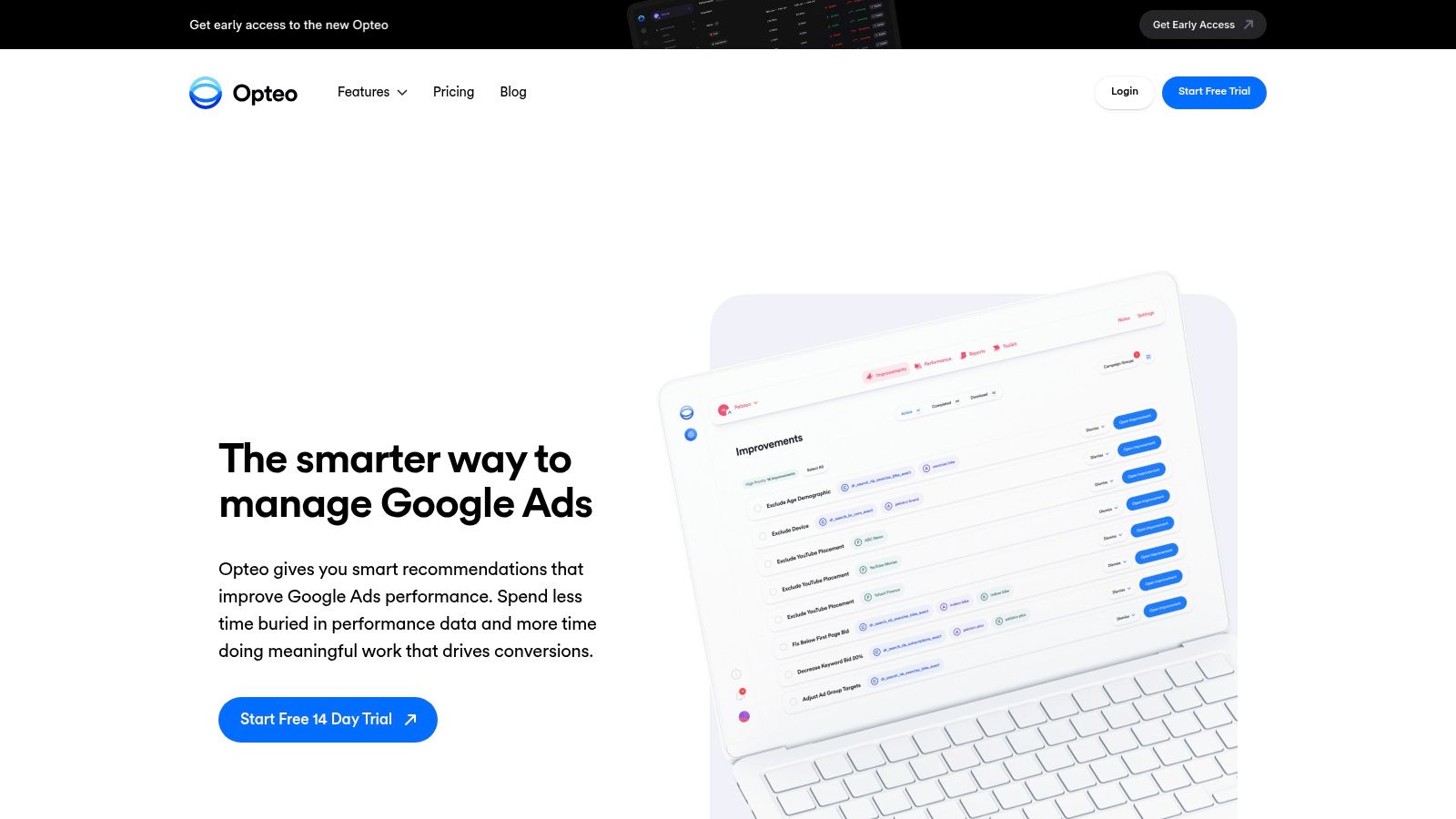
The appeal is speed. Opteo surfaces prioritized suggestions, ties them to Google Ads change history, and presents reporting in a way that clients can easily read. For freelancers and small agencies, that combination is useful because it reduces both setup friction and explanation time.
Why teams pick it
Opteo works well when you need a straightforward recommendation engine that doesn’t demand a lot of configuration. It’s also a good fit for agencies that want visible account changes without building a heavier governance stack.
Practical rule: choose Opteo when you want a low-friction Google Ads assistant, not a multi-network control center.
Limitations
The scope is narrow by design. It’s Google Ads-only, and it doesn’t try to compete with enterprise governance or cross-channel auditing. That’s fine if your work is mostly search, but it becomes a limitation once the portfolio expands beyond one network.
5. WordStream Google Ads Performance Grader
WordStream’s Google Ads Performance Grader is the fastest way to get a snapshot audit. It’s useful when you need an instant second opinion, a quick pre-meeting review, or a benchmark-style starting point before deeper work.
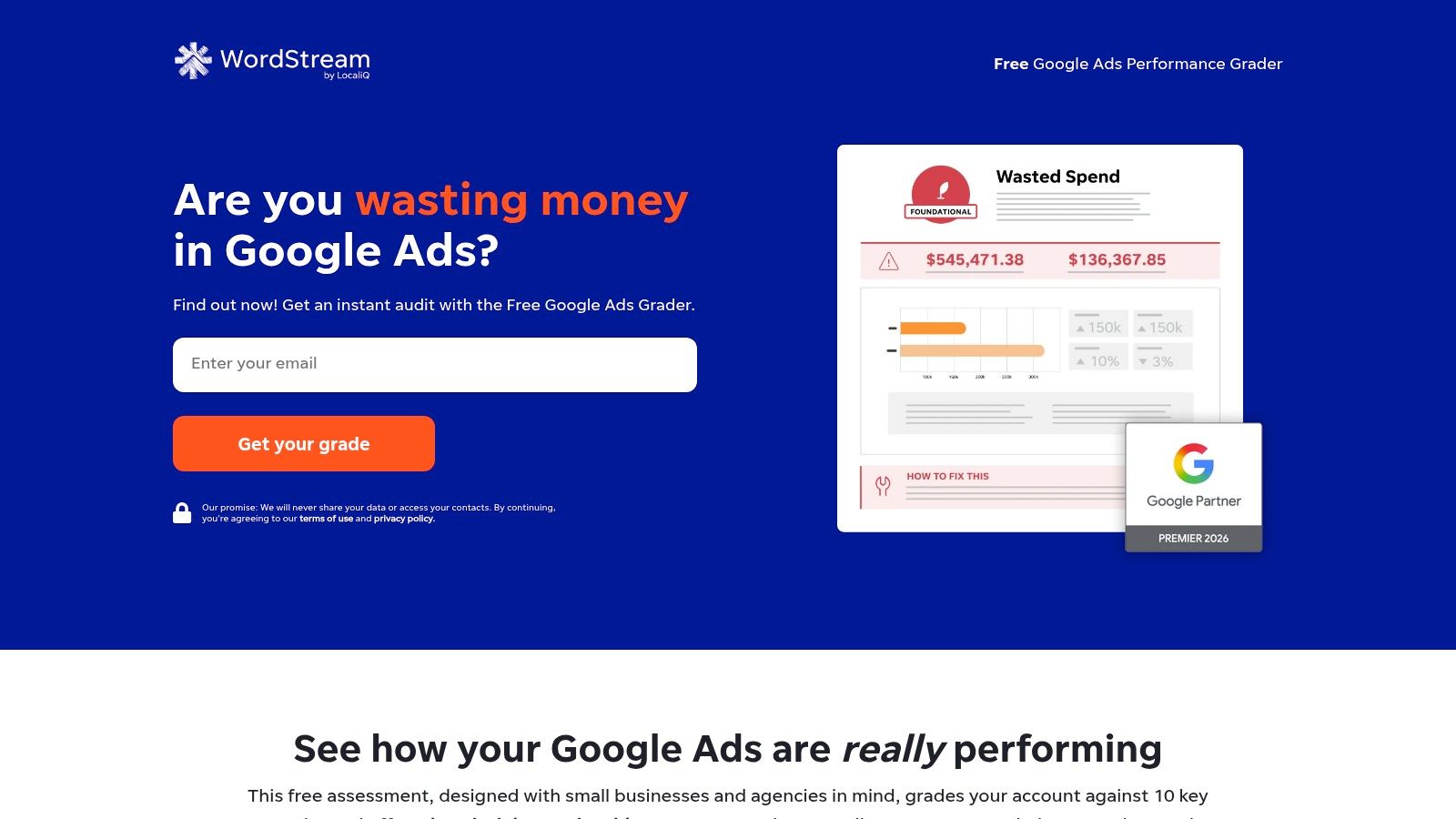
It’s a simple tool, and that’s the point. It checks familiar areas like wasted spend, CTR, Quality Score, and impression share, then gives you a short summary of what looks weak. That makes it a decent quarterly pulse check for teams that already have a more serious monitoring stack elsewhere.
The broader market context helps explain why this format still matters. PPC audit workflows have matured around core metrics like CPC, CTR, CPA, ROAS, Quality Score, and impression share in a discipline that now looks very different from manual account reviews, according to Superscale’s PPC analysis guide.
Ad performance metrics matter here because the grader is only as good as the team interpreting the output. It points to the issue, but it doesn’t manage the fix.
What it’s good for
Use it when speed matters more than depth. It’s free, fast, and easy to share internally. Use something deeper if you need continuous monitoring, governance, or cross-platform diagnosis.
6. SEISO
SEISO is a good fit when you want a recurring audit snapshot rather than a live monitoring platform. Its monthly report cadence makes it useful for teams that prefer regular visibility by email and don’t need constant alerting.
The value here is simplicity. SEISO highlights savings potential, best-practice gaps, and structural issues without asking the user to spend a lot of time learning a new operating model. That makes it appealing for teams that want a lightweight recurring review on Google Ads.
Best-fit scenario
This is a sensible choice if your internal process already handles action-taking elsewhere. The audit gives you a monthly reminder about account health, then your team can decide which fixes deserve attention first.
The limitation is timeliness. A monthly cadence is slower than continuous tools, so it’s better as a recurring checkpoint than as a remediation engine.
7. Karooya
Karooya is built around negative keyword analysis, which makes it especially valuable when wasted spend comes from irrelevant search terms and sloppy query traffic. It also offers a free PPC audit report, so the barrier to testing it is low.
That narrow focus is also its strength. If you’re trying to spot search-term leakage fast, Karooya gives you a very direct path into the problem. For search-heavy accounts, that’s often the first place waste appears.
Where it shines
Karooya makes sense when the audit goal is very specific, not broad. It helps teams quickly expose money leaks, then move into cleanup work campaign by campaign or ad group by ad group.
The trade-off is obvious. It doesn’t try to be a full-suite platform, so the interface and workflow are more utilitarian. If you need broader governance or cross-network support, it won’t be enough on its own.
8. Adsbot
Adsbot is one of the more interesting choices for teams that need a cross-channel view. It connects Google, Meta, TikTok, Microsoft, LinkedIn, Amazon, GA4, GSC, and Shopify, then uses an AI Audit to highlight anomalies and opportunities across that stack.
That breadth matters for agencies and in-house teams that don’t want to audit search and paid social in separate silos. A single pane of glass reduces context switching, even if some platform-specific work still needs to happen elsewhere.
Operational fit
Adsbot works best as a monitoring and diagnosis layer across multiple systems. It’s particularly attractive if your team spans search plus paid social and wants one place to spot problems before they turn into reporting headaches.
The catch
Broad coverage doesn’t always mean deep execution. For platform-specific builds and edits, a dedicated tool may still be necessary. Newer platforms can also evolve quickly, so it’s smart to verify how the workflow behaves in your own account mix before committing.
9. Madgicx
Madgicx is strongest when your audit needs are Meta-first. It combines analytics, automation, and creative insights, and it adds cross-channel reporting for teams that still want a broader performance view.
The platform is better suited to paid social teams than to search-heavy operators. That’s where its audit-style diagnostics and account-structure visibility matter most. If Meta is where your biggest spend concentration lives, the fit is straightforward.
Why it stands out
Madgicx gives you a way to inspect Meta account health and pair that with reporting across channels. That’s useful when performance reviews need a blended view, but the primary optimization work still lives inside Meta.
Limits to keep in mind
It’s not a full replacement for Google Ads management, and it leans more toward reporting than deep execution on search. Tiered pricing can also vary with ad spend, so it’s worth checking the current in-app structure before a trial.
10. Clever Ads Google Ads Audit
Clever Ads is a simple, free entry point for teams that need a quick Google Ads grade without buying a larger suite. It’s useful for first-pass scoring and for non-specialists who need obvious improvement ideas fast.
The audit format is lightweight, and that’s the main value. It can help a team spot visible misses, then decide whether a deeper platform review is worth the time. Optional Slack and Google Sheets integrations make it easier to pass findings along.
Where it fits
This is a good “start here” option when you don’t need enterprise governance. It’s also useful as a way to introduce auditing to people outside paid media who still need to see campaign health in plain language.
What to be careful about
Clever Ads is not a continuous auditor, and it’s not a full operating platform. For client work, the lighter footprint also means you should review privacy and terms carefully before relying on it in sensitive account environments.
Top 10 PPC Audit Tools Comparison
| Tool | Core features | Quality (★) | Pricing / Value (💰) | Target audience (👥) | Unique selling point (✨ / 🏆) |
|---|---|---|---|---|---|
| TrueClicks | Automated PPC audits, alerts, deep links for Google & Microsoft | ★★★★ | 💰 Free tier; paid can be pricey | 👥 Agencies needing scalable, unbiased audits | ✨ Audit-first hygiene checks; 🏆 strong agency reputation |
| Adalysis | Always-on 100+ checks, variance/root-cause, AI summaries, reporting | ★★★★ | 💰 Tiered by spend; strong ROI for mid→large | 👥 Teams wanting guardrails + practical fixes | ✨ Deep coverage + testing workflows; 🏆 mature docs |
| Optmyzr | Audits, rule automation, PMax governance, Campaign Automator | ★★★★ | 💰 Higher-tiered for volume/agency use | 👥 Agencies managing many Google accounts | ✨ Automation + governance + detailed apply logs; 🏆 operationalizes fixes |
| Opteo | Continuous checks, prioritized recommendations, change attribution | ★★★★ | 💰 Transparent, usage-based tiers | 👥 Freelancers & small agencies | ✨ Fast onboarding & clear to-dos |
| WordStream (Performance Grader) | Instant Google Ads scorecard & benchmarks across key metrics | ★★★ | 💰 Free | 👥 Small businesses & quick audits | ✨ Instant before/after snapshot; 🏆 long-standing tool |
| SEISO (JVWEB) | Monthly audit PDFs, health score, savings/opportunity highlights | ★★★ | 💰 Free plan with recurring reports | 👥 Teams preferring periodic snapshots | ✨ Simple recurring email audits |
| Karooya | Free MCC audit, negative keyword discovery, recommendations | ★★★ | 💰 Free audit | 👥 Search-focused advertisers | ✨ Strong negative-keyword “money-leak” finder |
| Adsbot | Multi-platform data unification, AI Audit, automation rules | ★★★★ | 💰 Newer product; pricing evolving | 👥 Teams needing single-pane cross-network view | ✨ Cross-network AI audit; 🏆 broad network coverage |
| Madgicx | Meta-first audit/insights, automation, AI assistant (MCP) | ★★★★ | 💰 Tiered by ad spend | 👥 Meta-heavy advertisers/agencies | ✨ 360° Meta audits + AI assistant |
| Clever Ads | Fast Google Ads grading, Slack/Sheets integrations, quick tips | ★★★ | 💰 Free / lightweight | 👥 Non-specialists & small teams | ✨ Easy first-pass audit and simple integrations |
Turn Audit Findings Into a Repeatable Operating System
The best PPC audit tool depends on what your team does after the alert appears. Lightweight graders work well for snapshots, continuous auditors are better for account health, and broader suites make more sense when testing, automation, and governance all sit in the same workflow. A team that only needs a quarterly pulse can stay lean, but an agency managing many accounts usually needs something that reduces both audit time and time to remediation.
That’s where the distinction between monitoring and execution really matters. A tool can flag wasted spend, broken tracking, or a bad structure, but someone still has to assign the fix, approve the change, and verify the result. If you’re operating across Meta, TikTok, and Google Ads, a separate execution layer can help close that gap. AdCrunch connects those networks, supports controlled Meta write actions, starts creations paused, and records every change in a permanent activity log, so the audit trail doesn’t disappear when the work moves from diagnosis to action.
A practical selection process keeps this simple. First, define the networks and account count you manage. Next, test whether the tool’s diagnostics are useful enough to trust. Then map each finding to a real approval and fix workflow, and finally compare reporting quality with the total operating cost. If the software only tells you what’s wrong, it’s a grader. If it helps your team act, document, and move faster across accounts, it becomes part of the operating system.
If you want to connect audit findings to action without losing control, AdCrunch is built for that workflow. It helps teams manage Meta, TikTok, and Google Ads from one place, then keeps every change in a permanent activity log. For agencies and multi-account operators, that makes the jump from diagnosis to execution a lot easier to govern.